Prepper Basics for Growing Your Own Garden

Prepper Basics for Growing Your Own Garden? Putting aside canned foods for future use is a good idea. But before that food supply runs out, you’ll need another way to take care of your family’s food needs. That’s why many preppers use gardens.

Prepper Basics for Growing Your Own Garden tray of vegetables

Growing your own food for your family is a great way to stretch the budget, eat wholesome foods and prepare for the future. You don’t have to have acres of land to plant and harvest the foods from a garden.

You can start a garden anywhere you live – even if you happen to live in an apartment. If you live somewhere, space is limited; you can create a garden in containers. But if you have a nice plot of land where you can plant, you need to choose the location wisely because plants have to have sunlight to survive.

Prepper Basics for Growing Your Own Garden

A garden also has to have good soil. Use organic fertilizer to enrich your soil before planting. You can have your soil tested before you start planting if you want to make sure that it’s healthy enough to sustain a garden.

Irrigation and drainage are important. You’ll want to make sure the area where you plant your garden isn’t in an area that holds standing water in heavy rainfall. If the water has difficulty running off, it can drown the plants.

Positioning is everything. Write down the foods you want to plant and how much of it you’ll need. Check out the climate zone for your area. This will help you learn what kinds of gardening foods will grow best in your area.

Will the plants get along with each other?

Make sure the plants you choose can be good neighbors. The types of food you decide to plant need to be placed in conjunction with their compatibility with other plants. Some plants will make it more difficult for other plants to survive, so separate them.

Some preppers plant a garden using seeds, while others use starter plants. If you want to be able to keep replanting your garden from seeds, then you’ll need to buy the heirloom ones since they’ll last for many replants.

What planting style?

You can plant your garden using rows, or you can use the raised bed method. There are pros and cons to each method. By simply using rows, you don’t have to create the raised beds.

But with raised beds, you can easily keep track of what food is in what location, and you won’t have to worry about one food shadowing another food. Raised beds also make it easy to harvest the foods when it’s time for them to be picked, and if something goes wrong in one raised bed, it won’t wipe out the entire garden.

Planning Your Prepper Garden According to Your Region

This is important when considering Prepper Basics for Growing Your Own Garden. Gardening is not the same in every state. If you’ve ever planted food in your garden and had it fail, you may have made the mistake of planting foods that are outside your region. The United States Department of Agriculture (USDA) has a map that can help show preppers which foods will grow the best in their region and when they should be planted.

Whether you buy seeds or plants, foods are labeled by their hardiness. Those labels are referring to the specific areas of a state where the plant will thrive. There are eleven regions divided by temperature into zones 1 through 11.

Southern states are divided by whether the area is coastal and tropical and whether they fall under the upper, lower, or middle South zone. A state can be all of one particular region or a mixture of two or three. For example, Florida’s region is entirely coastal and tropical, while South Carolina is a blend of coastal and tropical and lower and middle South.

Planning Your Prepper Garden According to Your Region with watering can

Some states are located in the Southwestern Deserts region. California is divided into zones by whether it’s northern or southern California, and divided b coastal regions and inland valleys.

The Pacific Northwest is a region, and the Western Mountains and High Plains is another. The remaining regions are the Northern Central Midwest, the Middle Atlantic, and the New England Region.

To locate your region, look on the USDA map for your state, and it will tell you what zone you’re in. The map will also tell you when to plant your garden. When planting a survival garden, you want to plant what will grow well in your region.

Grain and corn can grow well in almost all the regions, as will beans and peas. You can grow staples such as oats and barley, as well as tomatoes. Potatoes and carrots grow easily in most regions.

Cabbage, lettuce, and squash make excellent foods for gardening as well. Broccoli and herbs should be in a survival garden, and you don’t want to forget to grow fruits for making jams and jellies and for use in pies and other desserts. Fruits from the berry family (blueberries, raspberries, and blackberries) are easily grown. Don’t forget to plant a section for herbs.

Almost everything you grow in a garden, fruits, and vegetables, can be scanned and safely stored as long as you make sure the food boils for at least 10 minutes. Foods that you can from your garden can keep for years; they’re healthier for you and will hold their fresh taste.
Survivalist Seeds Are Vital to Long-Term Nutritional Needs

When there are no longer ways to purchase the foods needed for long term survival, you will have an alternative solution. The best solution is to have seeds that can be harvested from the foods grown and replanted again. These kinds of seeds can continually provide for your family year after year.

Picking the type of seeds you’ll want can be done in one of two ways. You can individually choose the seeds you want, or you can buy them in prepackaged containers. What you’ll want to look for are seeds that are clearly labeled as survival or heirloom seeds.

You want to be specific with this because these are the seeds that are packaged in a way so that their viability is guaranteed. Whichever seed choice you make, be sure that you look for ones that say they’re hermetically stored.

The way they’re packaged will keep them safe no matter when you need to open the container. They also continue to produce food gardens. You want these continually producing seeds because when there is no access to grocery stores and the types of prepackaged foods we get now if you plant seeds once and that’s it, you’ll be in trouble.

You can choose individually according to the types of seeds you get. You can buy vegetables in one group of seeds and fruits in another. You can also purchase what’s called medicinal seeds. These are seeds that will produce plants that are well known to treat specific ailments.
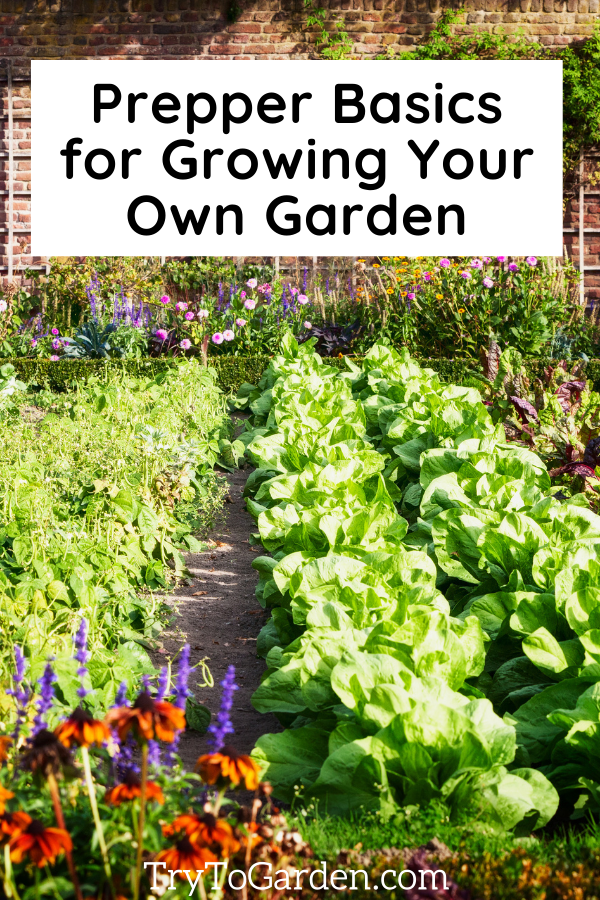
Prepper Basics for Growing Your Own Garden green veggies in rows

Some people, however, choose to create their own survivalist seed supply rather than buying them. If you decide to do this, you’ll have to follow a few rules. Don’t use wet seeds.

The seeds must be completely dry before you store them. The storage containers you use are vitally important. You have to protect the seeds from the ability to grow fungus, from marauding insects and animals, and heat.

For the best results, you’ll want to store your seeds in glass containers. You’ll want to maintain the right temperature for the seeds, and remember that some seeds can handle a colder storage temperature while others can’t.

Light and humidity will negatively impact a seed’s ability to produce a viable plant. You want to keep the seed’s temperature-controlled below 50 degrees and remember that while some seeds can last in storage for up to six years and still produce a crop, other seeds can’t. You’ll want to do a seed rotation to check and make sure that the seeds are still good before you need them.

Other articles you may find helpful if you liked Prepper Basics for Growing Your Own Garden:

The Basics of Homesteading in America

The Basics of Homesteading in America? The Homestead Act of 1862 promised 60 acres of land to families who stayed on the property for five years and farmed it for prosperity. Today, cities and towns are once again resurrecting homestead incentives – but for different reasons.

The Basics of Homesteading in America artical cover image with older barn

Instead of populating an area that’s never seen activity before, it’s now because of the need to settle places where homeowners and businesses have gone bankrupt and abandoned the location. 

The Basics of Homesteading in America

In just about every state in America, you can find properties and locations that are being given away for free – as long as a few provisions are met. For example, there might be a requirement that you have a contractor within a certain amount of time to begin building on a lot.

Another incentive is the tax break you get from developing one of these properties. Some cities give a generous 70% tax break for a while. Whether it’s a home or commercial development, you might even get a higher tax break. 

But not all free property is a suitable property for homesteading. As a prepper who wants to be self-reliant, you can’t just go into any area and take land and consider it worthy of raising a family. 

You may want to pay for your property instead – if it has good soil, an ample water supply, and is positioned in a way that enables you to have quick access without being readily found by the masses. 

Homesteading was officially repealed as a law in 1976, but you can still look for opportunities that specific places are offering for future developments. Cheap land is abundant, too – but the price isn’t the only qualifying feature. 

It would be best if you prioritize your needs. If you want to focus on farming, you need to secure land with rich, fertile soil that will yield a high dose of crops to feed your family. If your primary concern is isolation, then you’ll want more land at a cheaper cost. 

Land in the South will typically be less expensive than land up North – and the Southern states will have a longer growing season for those of you who want to farm and grow your crops. 

Make sure you understand the tax issues for the property you’re considering purchasing. Every state has different tax requirements, so while the per-acre price might be attractive, it might end up costing more in taxes than in another area where the initial price is higher, but taxes remain low. 

Homesteading Acreage Options

When you talk about how many acres are needed to get off the grid and become self-sufficient, the battle begins between those who say you only need 1 acre and those who say you need much, much more. 

Both camps are correct. It all depends on how you plan to live and how self-sufficient you truly want to be. You can live on a single acre and raise animals, grow crops, and build a home.

But you have to consider many things – such as raising a dairy cow. If you want to cut costs for hay, it has to graze in a pasture. If that’s the case, then it needs plenty of room, and an acre (that houses your home, garden, and other elements) wouldn’t be quite enough. 

The Basics of Homesteading in America raising with a cow

It’s not impossible, though. If you have the means to buy feed and hay instead of allowing grazing, then you could own a dairy cow on a small property like this – but your costs and inconvenience would increase, as would your reliance on the outside world. 

Raising a Homesteading Dairy Cow

Many homesteading prepper families decide to invest in a dairy cow for their property. This will provide plenty of milk for your family – and possibly extra for your pigs if you’re raising those. 

You can drink the milk or create yogurt, ice cream, and other items from her milk. Each type of cow and size will produce a variable amount of milk, so you may want to find a smaller option (like a goat) if your family doesn’t use much milk.

Or, if you live in a prepper community, you could share the milk with another family – along with the responsibilities of raising it. It would be best if you milked it at the same time every day, so scheduling is essential. 

Some people wonder about the safety of drinking raw milk, but you can also buy a pasteurizer for your family to use. They’re not expensive, and it will provide you with the same safety you get off the grocery shelves. 

It can get expensive to raise a dairy cow if you have to buy all of your hay, but many prepper families grow their own, so that cuts down on the cost of raising your dairy cow enormously. 

You can sometimes go to a dairy farm and ask if they have any lower production cows they want to get rid of. If the volume isn’t enough for a dairy farm, they’ll often sell off the cows to a family that requires a much lower milk volume. 

Most families recommend that you get a Jersey dairy cow, but there are many options. You want a gentle one and won’t be hostile to you or your little ones in a farming situation. 

You have to make sure that your property has room for her to graze and roam around. If you get a Brown Swiss or Dexter cow, you can allow for more grass grazing than hay feed, saving you money in the long run. 

Your dairy cow will provide milk twice a day for almost a year. After about ten months, give her a break for a few months and then let her produce another calf to begin milk production again. 

Keep in mind that your water supply must be significant to provide for a dairy cow’s needs. They can drink anywhere from 25-40 gallons of water each day. Make sure you have enough water for her and your own family’s needs. 

Your dairy cow might produce anywhere from 2-8 gallons of milk per day, so make sure you don’t over-invest in something that’s going to make all of the milk production go to waste. 

It also depends on how large your family is and how many people you have to sustain on your property. It’s going to take more of everything to support a family of five than it would a couple. 

Back to the Property…

Some people want a large piece of property only for the barrier it offers not to have neighbors bumping right up against your property. This could make a difference in civil unrest or crisis when people are fighting for survival supplies. 

You can’t neglect the fact that price will factor into the equation. Unless your pockets have no bottom to them, then you might have to consider how much you’ll be paying per acre – or how much money in taxes the government will require from you each year. 

Some families opt to invest in large plots of land so that when their children are grown, the family can expand and build a second, third or fourth home on the property. This is what families use to do in the old days, but now they’re all spread across the country. 

Some preppers will tell you that your land’s size is nowhere near as important as the quality of it. If it offers more than one entry to the property, rich soil, and a water source – that’s worth more than a larger plot. 

Prepper Homesteading Basics

If you’re going to homestead, you need to know the basics. But the first thing you need to realize about homesteading is that the goal is to become self-reliant. That means you can provide and care for your family entirely with what you can grow or make yourself. 

There are some skills involved with homesteading, but it’s not difficult to learn the skills. You’ll want to be prepared with food. You want to prepare with food supplies that can serve you for repeated cycles. 

Gardening

So you would want to plant a garden that can be replanted again and again. You can do this using heirloom seeds. You’ll want to plant what you’ll consume throughout the year and when the growing season is over, you’ll want to make sure that you preserve some of the garden bounty to use during the months that the garden doesn’t grow. 

You’ll also want to save and store the seeds from the fruits and vegetables for replanting the following gardening season. It’s also smart to learn how to construct chicken coops so that you can have the eggs that are produced. 

RAISING A PIG WHILE HOMESTADING

You can also raise pigs for meat. You’ll want cows for milk (and/or meat) and goats for producing dairy to use for cheese. Some preppers that homestead also prefer to raise honeybees. Not only is the honey usable, but the bees can help pollinate the fruits and vegetables that you grow. 

Water Sourcing

Water needs to be planned for when homesteading. You can’t survive without access to clean water. You need to set up rain barrels for water that your livestock can drink, and the collected rainwater can also be used to irrigate your garden. The fastest way to collect rainwater is to set a barrel up beneath a downspout. 

You should have a way to purify your water and a way that you can store the water. If you bring the water to your homestead site from a creek or pond, then you’ll need a way to transport it. 

Protection

Protection is paramount when you’re homesteading. You’re going to need weapons to protect yourself if someone decides to rob you or commit other crimes against you. You should be armed with both knives as well as guns. Both of these are great for protection and are handy to have around for hunting or food prep. 

If you choose to have firearms, seriously think about storing them safely. I found this $100 off coupon for you though a company I really like:

$100 Off Secure It Gun Storage AGILE 52s – Enter Code Agile52 at check out Shop Now

Homeschooling

Education for children is a necessity when you’re homesteading. You want to make sure you have educational supplies. You can find educational supplies at homeschool stores if you’re going to stock up in advance. 

You can also order and store homeschooling supplies in advance. But education can also be taught using just the necessary tools like classic pieces of literature. Teaching things like math can be done using real-life concepts such as measuring items in a recipe or measuring wood for cutting when building something.

Studies have shown that children who are educated using real-life ideas often excel in life. 

I know there are a ton of great mini lessons on my kid’s site Sarah Lyn Gay.

Homesteading Must-Haves

When you decide to go off the grid and build a family property that allows you to be self-sufficient and safe in the event of a crisis or disaster, you need to make sure it meets several requirements in addition to food and water. 

A good piece of property is first and foremost on the checklist. It should be away from the city, but not too far that it becomes an inconvenience to access whenever you need to replenish your supplies. 

The Basics of Homesteading in America farm at sunset with horse

It would be best if you had a spot that’s easy to access but is hidden from public view. You want to know where it is but not have it visible from the roadway where others might approach if there’s a disaster and they’re scouting for supplies. 

A good water supply source would be a great addition if you can find one. If it’s a flowing river or stream that would offer you freshwater, you can’t beat that since water is necessary for you to survive. 

Plenty of room for gardening and grazing animals is a perk. You need to figure out what kind of crops and animals you plan to raise since some will require more space than others. 

Good soil goes along with that last perk. If you’re gardening, you don’t want to be reliant on a store to sell you bags of fertilizer to enrich the soil. You want to land that’s already rich in nutrients and will help your plants thrive. How to Make Effective Garden Compost is a good article to read.

A method for generating your own electricity – hydro, solar, or wind would help your family survive. The running water with a drop in elevation would be good for hydroelectricity. Plenty of sun for solar, and winds of at least 9-10 mph for wind-generated electricity. 

Formidable building supplies should be brought onto the property. Concrete is a good building supply for protection from the elements. A safe room built into the property is wise for all kinds of events. You want it to withstand weather and prevent easy entry by unwanted guests.

Ample storage facilities are necessary. You need storage for items that can’t tolerate temperature swings, like your food stores and water supplies. Outdoor storage for tools, equipment, and other items are also needed. 

Protection from harm needs to be on your mind. Gates built around the property will help somewhat. Locks that come with doors and fences are often flimsy, so you may want to shore those up with something stronger. 

Firearms and a security system with rechargeable batteries can help protect you. Fire-resistant roofing material will help prevent your home from burning down if you’re in a wildfire situation. 

Concrete homes built right into the side of a mountain offer the best form of protection for the actual shelter itself. Then the property it overlooks could meet the rest of the requirements. 

Other articles you may find helpful:

Prepper Checklist for Cooking and Canning at Home

Prepper Checklist for Cooking and Canning? Cooking and canning foods at home is so easy that even a beginner can quickly learn how to master it. Making and canning foods at home is also an inexpensive and healthy way to provide food for your family.

Prepper Checklist for Cooking and Canning at Home article cover image with canned goods

It’s a method where you can set aside provisions in the event of a disaster. But if you’re going to use canned foods, you’ll want to follow this checklist to ensure that you have the right supplies and follow the important safety guidelines.

Prepper Checklist for Cooking and Canning at Home

The first items that you’ll need to line up are enough jars to hold the foods you want to store. How will you know how many jars you need? One way is by checking out what the recipe says. Home canning recipes will usually tell you how many batches of food the recipe will produce.

You can find jars that are specific for home canning. When you have the jars you need, you’ll want to wash the jars along with their lids and bands like you would hand wash dishes. This is done to remove germs and sterilize the jars.

The next thing you’ll need is utensils. You’ll need spoons and a spatula. You’ll also want to make sure that you sterilize the utensils you use. When you’re canning foods, you don’t have to have many items, but you do want to make sure you have a sturdy stockpot.

You might find it helpful to have a funnel, labels, and a canning jar holder. If you’re canning fruits or jellies, you may also want – pectin, but some people can foods without it – it’s a personal preference.

Once the water has simmered in the pot, you’ll want to fill the jar to the level that the recipe calls for. Don’t put warm foods in cool jars because this will cause the jars to shatter. The jars need to be at least room temperature.

To get out the air bubbles, make sure you don’t stir – just run a flat utensil around the inside of the jar. Put on the lid toppers and the rings, then place the jars in the jar lifter. If you don’t have a jar lifter, you can use tongs in a pinch, but it’s easier for the jar to slip with tongs.

Using a jar lifter, you would lower it by the handle into the stockpot until the jars’ tops are completely covered by water. Let the water boil however long the recipe says to let it boil.

You don’t want to count the time before the water boils. Once the jars are cool, some people put labels that are dated on the outside of the jars so that they can rotate the foods while they’re in storage.

Which Prepper Recipes Should You Compile?

What Prepper Checklist for Cooking and Canning would be complete without talking about recipes? When it comes time to live off of your survivalist food stores, life might make a chance for you and your family at mealtime. You can no longer run up to the corner store for foods to go in a recipe – you have to have it on hand or make do with what you do have.

You’ll want to look for certain types of recipes that work with the kinds of foods most preppers store – but also locate recipes for your files that create meals your family loves.

The primary focus for many preppers is on beans, bread, and canning recipes. But that’s not your only option. You will probably be storing lots of rice, freeze-dried or dehydrated foods.

You want to be able to turn those staples that your family has worked hard to store into an almost gourmet meal that you’d be proud to serve to dinner guests during a typical celebration.

Start organizing your recipes offline. Many people have them stored on sites like Pinterest, but if there’s no electricity, you won’t be able to access those recipes at all. It’s better to print them out and save them in a small filing storage container.

Organize your recipes according to what staples your family has on hand. If you find a recipe that calls for something you don’t yet have, add that item to your checklist of food storage items to get. We like this list we found here: 45 Pantry Meals for Tough Times or Tight Budgets.

Put the recipes in categories for entrees, side dishes, bread, and desserts. You might even want to have one for beverages if you’re able to store different types of ingredients to make delicious drinks.

Too many preppers who are just starting out think that emergency food stores would mean you have to live on meals ready to eat or plan meals that offer no sense of enjoyment.

During a crisis, you want to provide your family with the most normal routine possible. Sometimes that means being able to serve up favorite family meals. You may have to create substitutions for certain things, but it’s better than living on a protein bar day after day.

Using your prepper food stores means rotating items out of commission, and you can invest in survival cookbooks and test out your prepper culinary skills using a variety of methods – including solar ovens and other forms of cooking without electricity.

If you have children, make sure you have them help you compile a list of their favorites, too. They can even help you make a test batch to see if it passes muster with the whole family and earns its spot in the recipe container!

Other articles you may find helpful:

Which Survival Vehicles Should You Own?

Which Survival Vehicles Should You Own? Flashy cars are certainly a status symbol – and there’s nothing quite like cruising to the beach in a newer model convertible with the top down and the wind on your face. Except the flash won’t do you any good when a disaster strikes.

Which Survival Vehicles Should You Own article cover image with a camper on it

When a disaster strikes, many people become stranded because the roads are impassible to ordinary cars. Debris clogs the roads – and if you try to take a flashy little car over debris on the road or through the slick mud-covered trails, you’re not going to make it very far.

Which Survival Vehicles Should You Own?

You have to have a vehicle that’s not going to wimp out when there’s a little trouble on the road. You need to get a four-wheel drive that will give you the traction you need when things get a little rough.

Not only do you need a four-wheel drive, but you have to have something that gives you some space. Having a small four-wheel drive is okay if it’s just you. It’s okay if you and your family want to run up to the corner supermarket, but loaded down with all the gear you need to take, that small four-wheel drive isn’t going to make the cut.

So get a vehicle that offers you all the room you and your family will need to pack it up and haul out of any bad situation. You want something easy to maneuver – so that doesn’t mean that you have to go out and buy a truck with monster wheels.

You need to be able to get the vehicle through the area you want to go. So a good rule of thumb is to get a vehicle that can handle going off the road and make sure that you, your family, and all of your bug-out gear can easily fit into it.

Sometimes, not even a decent vehicle is going to cut it when the road floods. To make sure you’re covered by land or by water, you should have a survival boat. Don’t waste your time on an inflatable boat for long-term use.

The debris in the water will make sure it doesn’t last very long. You want something that your family can bug out in – but something that will also provide shelter if you have to stay on it for several days.

In the best scenario, a boat is merely a means of getting where you need to go, but the great thing about boats is that you can buy one that’s big enough to hold all of the equipment you need to survive temporarily.

You also want to have a four-wheeler. You want to have a four-wheeler if you need to get out and your vehicle can’t make the trip out. You can use the 4-wheeler to transport yourself and your family members (even if you have to make several trips) to an area where your boat or an alternative escape means awaits.

free shipping banner

The Top 5 Prepper Survival Vehicles You Can Own

When it’s time for survival, or when you’re planning to live on your own homestead off the grid, you want to have various vehicles at your disposal. The terrain will be different depending on where you live and where you want to get to, so you have to plan everything in between.

PREPPER VEHICLES

1 – Trucks or SUVs are good for carrying lots of items for a short-term emergency. They’re durable and can help you pass over things that a regular small car may not make it past.

2 – Motorcycles, Bikes and 4-Wheelers are essential because it allows you to get through certain obstacles without a lot of room necessary to get by. They’re also good for going off-road.

3 – Boats, Canoes, and Amphibious Craft are perfect if you need to go in or on the water. You might start with a small watercraft and build up to a formidable yacht that would take you seaward if you needed to go that route.

4 – Campers and Trailers are great for families who want to have a bit more protection than what a tent allows for – and they’re portable without having to pack up and set up every time you need to move. Trailers can store supplies for you while campers give you a ready-made shelter. We like Crazy Camping Gal for all things camping.

5 – Horses aren’t usually considered a vehicle, but you must have a way to navigate without fuel, and animal transportation is the way they did it in the old days, and it isn’t too good for us in a crisis now.

If you are building a homestead somewhere other than where you live now, and storing vehicles at another property, make sure you maintain their care. A car that goes unused can develop flat tires and rot in its shell if enough time goes by without it getting turned on and maintenance.

Consider getting some additional accessories for your vehicles, like fuel bladders that you can fill up and take with you if gas stations aren’t working or aren’t in your vicinity. Luggage racks might also help if you have more to carry than what your trunk allows for.

Consider getting the best off-road tires you can afford. There may be many cases where the roads are blocked with obstacles, or they’re not safe to travel openly – and you’ll want tired you can depend on to take you off into unpaved terrain.

Other articles you may find useful:

Which Survival Vehicles Should You Own with a horse

Setting Up Your Survival Seed Bank

Setting Up Your Survival Seed Bank? Some people avoid reading or watching the news because they don’t like what’s going on globally. But avoidance can’t stop what’s coming because you can’t control the things that affect the world’s food supply. 

Setting Up Your Survival Seed Bank article cover image with seeds

There’s an impending sense that a major food crisis is on the way, and the government is trying to prepare right now for that crisis.

Setting Up Your Survival Seed Bank

But if you know anything about how the world is run, then you know that if you’re not the one in charge of your family’s food supply, you and your loved ones could very well end up standing in a ration line or worse – going hungry. 

Why You Need to Have a Survival Seed Bank

Far too many people have the mistaken belief that if something terrible does happen that interrupts their access to food supplies, the government will have a backup plan to save their family. 

When millions upon millions of people rely on the same belief that there will be enough to go around, they’re going to end up disillusioned. There won’t be. The government isn’t going to be prepared for any major food crisis. 

SURVIVAL SEED BANK

Why? Because they can’t stockpile enough food to feed millions of people for a long-term situation. You might think that the hope for relief from a food crisis lies at the base of Mount Plateau in the depths of the Svalbard Global Seed Vault, which houses the world’s biggest seed storage. 

But the seeds in this vault aren’t coming to your rescue, and you won’t be able to get to those seeds. Take a look in the mirror. You’re looking at the person who’s your best chance of survival. 

It’s up to you to know what to do and to be prepared for any food emergency. That means that you’re going to need to understand how you can live off the grid. When every method of getting food is suddenly stripped away from you, it can’t be the catalyst that rocks your world. 

You have to have a way to replenish your food supply long term. Even if you have some canned goods socked away in the event of a flood catastrophe, having goods that will last you a few years isn’t enough. 

You have to be able to bring food back in. And if there’s no way to get food from a grocery store and the government’s hands are tied, then what are you going to do? You need to be able to have a survival garden that will take care of you and your family’s nutritional needs for many years to come. 

You start this by having the seeds that you need to raise a survival garden – and you need to have enough of them to plant a few acres’ worth of food. This means that you need to have the kinds of seeds that can reproduce themselves. 

They’ll keep on producing for you. And you also want to look for seeds that haven’t been modified. When you plant seeds from a seed bank, you can guarantee that you’ll have food year after year – regardless of what’s going on in the rest of the world. 

Using seeds from the foods you grow (and replanting those once your crops come in), you’ll ensure that your food supply will continually produce. You want to make sure that you look for seeds that offer a lot of produce return and ones that are high in nutrition and are long-lasting. 

What Seeds You Need to Have in Your Survival Seed Bank

To sustain life, certain seeds are a must-have, so the seeds you buy for your survival seed bank need to have these seeds in the container. It would be best if you had a variety of beans. 

Some of the better varieties are bountiful beans, October beans, and stringless black Valentine beans. Beans can produce a crop in a time frame of 47 to 90 days, depending on the type of bean seed you choose to plant. 

HOW TO SAVE SEEDS

Beans are staples that provide you with protein as well as fiber. Beans are also very sturdy crops and can produce an abundant supply of food. Because of their protein and fiber content, they can give you plenty of energy. 

Corn seeds are something that you also need in your survival seed bank. Corn is a staple food that can keep your family sustained for long term food survival. You’ll want corn that can grow quickly, in less than three months. 

For that, look for seeds like Reid’s Yellow Dent Corn or Stowell’s Evergreen Corn. These usually grow in twin ears with an average length of between 8-10 inches, so they’re very hearty. 

Cabbage seeds – like the Copenhagen Market ones – need to be in your seed bank. These heads usually grow to be a decent size and offer gardeners a little over 3 pounds of cabbage per head. They can reach maturity in just over two months. 

When considering which seeds to get for your seed bank, you want to take a look at how those foods will help you maintain good health. You’ll want to look at whether they offer anti-inflammatory properties and other benefits. 

If you choose beet seeds like Detroit Dark Red Beets, these are a food loaded with anti-inflammatory assistance for you. Plus, they promote some internal organ benefits, too. These seeds can reach maturity in about two months. 

Remember when your mom told you to eat your greens because they’re good for you? She was right – especially when it comes to spinach grown from Bloomsdale spinach seed. 

These will grow into tasty plants that are packed with nutrients, including the A and K vitamins. Plus, they’re rich in Vitamin C and folate. These seeds produce a fast crop, and you can usually have viable plants in about six weeks. 

You’ll also want to get loose leaf lettuce such as Oakleaf or Red Salad Bowl for greens. Both of these seeds can reach maturity in less than two months. Other greens you’ll want to include in your diet are Green Arrow Peas. These can be harvested in about two months and produce an abundant crop. 

Cucumbers like Bushy Cucumbers are also a great addition to your survival seed bank. These can be ready for harvest in about six weeks. Carrots are also part of a healthy diet. Seeds that produce Scarlet Nantes Carrots can be ready to eat in a little over two months. This kind can usually grow carrots of about 7″ in length. 

Tomatoes can be eaten fresh, canned, or juiced, and ones that come from seeds like Brandywine Tomato. Not only will you get plenty of antioxidants, but these are loaded with vitamins as well. 

Squash and Eggplant also add much-needed vitamins to your diet. Look for ones like Waltham Butternut Squash and Rossa Bianca Eggplant. Don’t forget to bank plenty of fruit seeds like cantaloupes and melons and other varieties. 

You’re going to want to make sure that you have a wide selection of good choices to grow, not just for the vitamin and mineral content but also for each family member’s taste and preferences. 

If you’re wondering where you can get the seeds, you can find them online at specialty companies or online shops. You can find significant savings by buying the seeds in bulk, as well.

How to Store Your Survival Seed Bank

It would help if you had your survival seeds to start the garden that’s going to keep you and your family sustained for however long it takes. Right now, with food still being plentiful and most people able to get whatever they need from the grocery store, seeds aren’t considered all that valuable. 

But when a crisis hits and gets food becomes a free-for-all frenzy, the seeds you have will have a high value. Think of these as your currency and amass as many of them as you possibly can because once the crisis is here, it’s too late, and there will be a run on survival seeds. 

Setting Up Your Survival Seed Bank

When you have these in your possession, you don’t want to go around talking about the fact that you have them. Keep your survival seed bank hidden away, out of sight from prying eyes, to keep the seeds from getting stolen. 

Most survival seeds are shipped to you in packaging that makes them able to be kept viable in storage for a long time. Some of these are stored in such a way that you can even bury them to keep them safe. 

Seeds need to be protected from bacteria, fungi, pests, fluctuating temperatures, and moisture. The most critical issue you need to know about storing seeds is that humidity is not your friend. 

If moisture seeps into your seed storage, it can ruin it. And moisture isn’t the only culprit that can harm your seeds. If you keep the seeds stored in an area where the temperature is too high, it can cause some damage to the seeds. 

You want to make sure that the moisture percentage is kept as low as possible. If you can get it to less than 4 percent, that’s considered a safe moisture percentage for the seeds.

The storage temperature needs to be kept around 40 degrees. By taking care of how you store the seeds, you can ensure their longevity. You also want to make sure that you don’t keep your seeds anywhere in the sun. 

The sun’s heat can change the storage temperature, raising it above healthy seeds. If moisture and heat combined get to the seed, it kills the seed’s ability to grow plants. 

When you get the seeds, if they’re not in containers that are said to be moisture-proof, then you need to be put them in ones that are. When you harvest the crops that you grow from your original survival seeds, you’ll want to save those seeds as well. 

This is an essential step in banking seeds because you don’t know if you’ll have access to them anymore once your original supply has been planted. You’ll want to air dry the seeds from the crops you harvest and then securely store them in water-proof containers in a cool, dark place until it’s time for you to use them. 

When and How to Use Your Survival Seed Bank

As you know, timing is everything. That includes learning when to use your survival seed bank. You don’t want to rush and use the seeds too early – but you don’t want to wait so long that you miss out on the right time. 

You need to be aware of which climate zone you live in because you can’t just plant seeds and expect them to grow if the season that you’re currently in would only end up derailing your plans. 

All of the seeds should be planted according to the hardiness zone of your state. This means that your area will have a certain level of temperatures that make growing a garden with your survival seeds a viable option. 

Planting too soon or too late could not only diminish your crop yield, but you could end up not getting any produce at all – and you don’t want that kind of waste. Plus, counting on having a food supply and ending up not getting it could be a significant stressor for you. 

Plant your garden during your climate zone using your survival seeds when you begin to notice that a food crisis is imminent. And make sure you plant it before the time is at hand to need it. 

You can feasibly plant with your survival seeds and keep the garden producing for years. Remember to always aim for a garden that’s as carefree as you can make it. You’ll want to use your survival seeds to plant a garden that will sustain you and your family with as little fuss as possible. 

This way, you won’t be using any physical labor or any other means, such as bringing in water or setting up a water system. You also want to make sure that you plant your seeds so that you won’t draw attention to whatever it is that you have grown. 

If others see it, your garden could be a target. This means that you can forget about the kind of gardens you see that have perfectly uniform rows. Instead, plant a garden using your banked survival seeds and let nature help you grow that garden. 

Nature is perfectly capable of maintaining crop growth with a minimal amount of effort from you. Layout the garden so that you’re using the ground wisely. This means that you’ll want to plant seeds where the crops can grow together in companionship. 

You’ll also want to plant your seeds according to the height and sun ratio. That means that you need to plan out your garden so that each plant has access to the sun and the right amount of moisture. 

Some seeds offer natural pesticide control. For example, marigold and lavender are both natural pest repellents. Put the taller plants around in a perimeter to help shade crops that need less sun than other plants. 

Usually, this means you plant your bush-type crops. If you use crops that can benefit your pollination purposes, this can help your crops grow. Plants that are used for pollination purposes are seeds that produce fruit – like blueberries. 

If you’re someone who doesn’t have any experience with growing food, then you’re going to want to know how to do it before the time arrives that you must have the knowledge, or else it puts your survival at risk. 

Remember, in an emergency; you may not be able to log onto the Internet to find the answers you need. The best way to learn how to have a successful garden using survival seeds is by going ahead and getting some seeds and planting a garden. 

This way, you’ll already know what to watch for, what didn’t work, and what does work in preparation for the time you need to have the food supply ready. You can also plant other vegetation to help you hide your crops. 

For more gardening tips check out Try To Garden .

Other articles you may find useful:

Survival Prepping on a Budget

Survival Prepping on a Budget? Preparation is always the key to surviving whatever life throws at you. Some people try to be prepared for short term situations because they usually think that life will go back to normal quickly. 

Survival Prepping on a Budget article cover image of a woman doing finances

If you’re prepared to rough it without electricity or being able to run down to the store to buy food for only a day or two, you’re probably woefully unprepared. If you’re like most people, you don’t have a lot of money to spend on things that you don’t need to use right now. 

Survival Prepping on a Budget

That’s why it can be all too easy to push survival preparations to the back-burner. But you can take care of your survival needs even if you’re on a budget. You have to do it piecemeal and follow through with your plans.

Make a Plan So You Don’t Buy Haphazardly

Not being familiar with how survival prepping should be handled can lead you to make mistakes with the items you should have on hand for you and your family. 

If you think that prepping means making sure you have enough supplies to make it in the event of a crisis that disrupts the ordinary way of life, you’d be right. But that doesn’t mean that you run out to the huge food storage warehouse and start throwing cans of tuna in the cart. 

Not knowing for sure what you need to get is a fast way to end up short on supplies, not to mention it’s a way to waste the money you have. Having a successful survival method means that you have to plan it. 

You can’t run to the store and haphazardly buy whatever looks like it’ll keep for a while. It would help if you had a checklist of what you should get. This checklist should always start with the items that you must have first. 

Not every item for prepping is needed right away. You always want to start with the most important things first. These will be items that your survival will depend on. 

Usually, what this means is that you plan to buy the basics. It would be best if you started with basic food and water supply since you can’t survive without either of these for very long. 

If that makes you nervous, remember that you can start the short term with the plan to build toward a long-term supply. So your first step would be to aim to stock up a three-day supply of food and water. 

You’ll need to do this for every member of your family – including your pets. For your water supply, you’ll want to look for ones labeled emergency water pouches or survival water pouches. 

These come in packets for easy storage, and you can get them in a three-day supply. That’s your first goal. Keep your plan focused on setting aside supplies for 72 hours, then move on from there. 

Once you have your water supply set aside, then you’ll want to move to your food supply. Just like with the water, you’ll want to make sure that you have a three-day supply of food on hand. 

Figure this for each person. What you’ll want to look for are the emergency food bars that offer around 400 calories a bar and come in different food flavors. 

Be Picky About What You Splurge On

When planning for your survival, it can be easy to get caught up in what you think you have to have. This can lead to unnecessary splurging, which will then eat into the money you have to spend on what you need.  Survival Prepping on a Budget is all about being concerned about how you spend that precious money.

As you start to prepare, you’ll find that you’re faced with many different choices on what you need. Some of these items will be worth you spending more money on, but some of the things aren’t. 

If you’re faced with a situation and need to get out of your house, you’re going to need a way to carry a 3 day supply of food and water. You should have these items already set aside and waiting for you to grab and go. 

These are often referred to as bug out bags or BOBs. These bags should be made of durable material and should be strong and should be water-resistant. 

SURVIVAL PREPPING ON A BUDGET

Buying cheap bug-out bags has the potential to ruin your supplies – so in this case, it’s a good idea to splurge on a good bag. What you want to look for are bags that have good load-bearing ability. 

You’re also going to want to make sure that you have a good dependable communication system. This system could be your only link to knowing what’s going on, and it can be invaluable for helping you to be able to reach your loved ones. 

What you’ll want to splurge on are communication devices such as ham radio or world band radio. You might also want to consider a short-wave radio. Splurge on a decent antenna and a solar charging system. 

What you don’t want to splurge on are items that have many features, can’t be carried along if you need to get out fast, or don’t have a lot of bang for the buck. For example, you’ll need a camp stove. 

You’ll want to splurge on a good one, but you don’t have to get one that has a ton of extras. A camp stove for $20 works just as well as the ones you can find for almost $100. 

When it comes to your eating supplies, you do want to splurge on heirloom seeds. This will be the foundation of your survival once you have your short-term supplies in place. 

This is what you’ll use to create your long-term survival garden as well as keep you and your family fed for the future. 

Buying in Bulk to Cut Costs

It makes sense when you’re buying the way you usually buy your supplies to buy what you need until you can replenish your supplies. But buying supplies for survival prepping works better when you buy them in bulk. Survival Prepping on a Budget means getting more, for less, every time you can.

Retail stores and online stores will always offer a better deal on supplies when purchasing more of them. You can quickly pay around $15 for a month’s supply of emergency survival food bars – but if you buy them in bulk, you can often get a deal where you only pay $60 for a six-month supply, so you end up saving $30. 

The best areas to look for savings on bulk items are going to be in all your basics. You can save money by buying your water in bulk. You’ll save if you do the same for your food or seed supply, too. 

It’s cheaper to buy sees for a year than it is for a few months. Since you’ll need these items anyway, it makes sense to buy them in larger quantities. If you know you want to buy a bulk item, set aside a little money at a time for a larger purchase. 

Also, watch for sales where you can buy items in bulk. Many stores will offer double coupons or bulk purchase deals on things you’ll need. Follow the lead of couponers who do strictly to save money. 

You’ll need a checklist when you’re buying in bulk, not to forget how much of each item you have. Staples are where you’ll begin. Start by purchasing bulk packages of rice. 

You’ll often find these in 50-pound bags. Make sure that you buy your sugar in bulk, too. You can find these in 25-pound bags, and often, they’ll be plastic wrapped together, enabling you to buy them in twin packs or more. 

Get your flour in bulk as well, but make sure before you buy that you have proper storage containers in place to prevent pests from getting into your food items. 

Buying coffee and tea in bulk will also cut your costs. Create a store of powdered milk as well. Stock up on different types of beans, too. Buy your canned goods by the case. 

Survival Prepping on a Budget pink piggy bank

You can find these in 12 to 24 can packs. Any food that you normally eat that comes in a can you’ll want to stock up on. These canned foods are often useful for many years from the date when you purchase them. 

What you’ll want to do is keep an eye on the expiration date and rotate them into your normal meal planning if you have to. Then replace your stock with a new batch that has a later expiration date. 

Besides making sure that you buy water and food in bulk, you’ll want to get your hygiene items this way as well. Stock up on supplies like shampoo and soap, razors, toilet paper, feminine products, diapers, deodorant, toothpaste, and lotion for dry skin. 

Stock up on detergent and bleach – especially bleach – because it can be used to disinfect. Getting your medical supplies in bulk will save you money, too. You’ll need to create a store of bandages, gauze, medical tape, disposable gloves, compress, thermometer, antibiotic ointments.

free shipping banner

Make sure to add a first aid kit, wraps, medication to treat sickness or injuries, tweezers, eye drops, sunburn cream, insect bite, and poison ivy treatments. 

Adding to Your Arsenal of Supplies a Little at a Time

Indeed, we often have an all-or-nothing mentality. When it comes to making sure our needs or the needs of our loved ones are met, we want to go all out. With survival prepping, being fully prepared can be expensive. 

But fortunately, you don’t have to buy every one of the supplies that you’ll eventually need all at once. Buying what you would need to survive for the first 72 hours is a good start, and you don’t even have to buy all that at once. 

You can start by focusing your spending power on getting enough water and food for everyone in your household for one day. Then stock for the second day and so on. 

Once you’ve reached your store of three days’ worth of supplies, then you can start adding to your arsenal – hoarding enough for a week, a month, three months, and finally, a year and more.

As you start your supply, look at it like you’re going grocery shopping and get the items you would typically buy at the store but buy them in bulk. If you don’t have a food warehouse membership, that’s not a problem; you can buy what you need online. 

And you don’t have to stick with one supply at a time, such as buying several bags of 25 pounds of rice until you have a reserve. You want to concentrate on getting some of each category of the supplies and then rotate back through it again.

So you would buy your staples one week, making sure you get a large bag of rice. The next week, you would buy the flour, then after that the sugar, and within weeks, you would have your staples knocked off your list. 

That’s the way that you would handle every category. It’s probably wiser to buy your hygiene items while you’re buying your staples because you’ll need those things. 

When you write your list of supplies, put a heading for each area you’ll need to cover for your survival. After food and water, you should have areas marked as tools, shelter, communication, purification, heat, and so on. 

Under the heading of tools, you’d want to start stocking up on items like knives, self-defense weapons, multi-tools, axes, binoculars, shovels, and paracords flashlights, fishing gear, fire starter, manual can opener, cast iron pan, and more. 

For shelter, you would want to make sure you have a supply of Mylar emergency thermal blankets, sleeping bags, a good tarp, and tents. Weather gear can go into that category as well. 

These would be items like a poncho, rain boots, etc. Purification methods are needed because if you find water, you can use that if needed. Some of the methods used are filters or water purification tablets. 

Buying at Certain Times to Save You Money When Survival Prepping on a Budget

It’s a well-known fact that when a crisis is raging, there’s often panic among the masses. One of these reasons is that the media will often excite situations to drive up the ratings. 

This works because it whips people into a frenzy, and they make a run on supplies. You’ve probably seen empty grocery store shelves during times of uncertain weather. 

When this is going on, it will often create a state where the demand will exceed the supply, which only fuels more panic. What retailers do in response to this panic is they will jack up the prices. 

While it’s wrong of them to feed on people’s fears, it’s simply what they do, and it’s been done time and time again everywhere. So while you want to make sure that you get all the supplies you need to have your survival preparation supplies on hand, you want to be careful as far as the timing goes. 

By paying attention to specific times and what’s going on in the world around you, you can save money. When the news is all about doom, gloom, and panic, you shouldn’t buy any of your prepper supplies. 

You’ll only end up being overcharged. The time to purchase supplies for your survival prepping is when life is business as usual. This way, you won’t pay more than you should. 

However, there’s also another time that you should buy your necessary supplies, and that’s during times when there are sales. Throughout the years, various retailers will hold sales. 

You’ll see sales on holidays like Black Friday, Cyber Monday, and other days. Watch for the supplies you need to go on sale then, especially if they’re the more expensive items. 

Pay attention to in-store sales, discount sales, and bulk buying sales. You can usually find something on sale in every one of the categories on your list. Keep it handy (and updated) and carry it with you at all times just in case. You will find that Survival Prepping on a Budget is easier than you originally thought.

Survival and prepping is something every household should be doing, regardless of their level of income. Dire situations don’t discriminate when it comes to wreaking havoc on society, and you want to be just as ready as your neighbors (if not more so) when anything causes you to go into a bug-out mode. 

No amount of prepping is too small. If all you can buy is an extra 3-pound bag of rice, then do it. A couple of cans of soup here and there is also a start. Don’t wait until you have plenty of extra money to buy everything all at once. 

Like Survival Prepping on a Budget? Here are Other articles you may find helpful: